Losing in Sports and Art is OK
I felt I’d lost for good at theater and sports before I turned 18, but those disappointments only strengthened my resilience.
By Logan Reitzner
Theater and sports both deliver their share of disappointments. Actors don’t get the parts they want. Players get cut from teams. Both pursuits can be cutthroat and require practice to build resilience.
Nothing is easy.
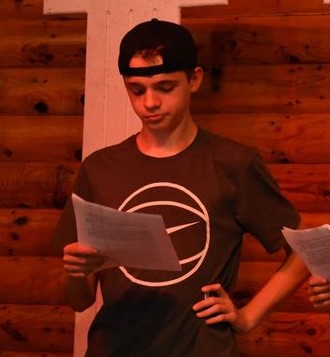
I was a skinny 130-pound kid with a buzzed hairstyle from Sports Clips and wearing Adidas sweats seven days a week. I loved theater and sports. During my freshman year at Eagan High School, I was trying out for the lead role for “You Can’t Take it with You.” I was always cast as the comedic role in middle school and wanted a role that did not require me to play the fool.
I bombed the audition. I went to my room and hid there sitting on my Xbox playing Minecraft in the pitch black. Sure enough, the call back list came out at 8 p.m. When the email notification popped up, I saw close to 25 names on the list. Mine was not among them.
I had done theater for at least six years at that time and had dealt with not being cast in roles I wanted. But this disappointment of not being cast in my first year of high school was different. It felt like a sign. So I quit theater entirely and focused on sports.
About two years later, I sat in an MHealth Fairview Clinic in Eagan, Minnesota, waiting for the doctor to clear me for track after a high ankle sprain I had sustained from playing recreational basketball. But after the routine checks by the nurse at the start, the doctor walked in and grabbed a stethoscope. The metal felt like ice touching my skin as the doctor started checking my breathing patterns from the back to the front and then immediately ordered more tests, including an EKG .
Eventually, the news came: I wasn’t cleared for the track season, and it wasn’t because of my ankle. I had an irregular heartbeat. My heart was one beat faster than normal. My dad and I were in complete shock.
In sports, athletes are never guaranteed anything, especially the longevity of playing competitively. It took me three months after being diagnosed before the doctors could clear me of my irregular heartbeat. They could not give me a direct explanation of what caused it, so I was scared and had to make a decision about my future.
I was just in high school. But in that small way, I learned the lesson that great athletes inevitably learn if they play long enough. Everyone stops playing. Losing is the other end of winning.
“If you lose, you lose more than the game —you can lose your job,” Gay Talese, the famous writer and journalist, said to the New York Magazine in 2010. He was talking about his 1964 Esquire magazine story on the boxer Floyd Patterson called “The Loser.” Patterson was famous for being the youngest heavyweight champion at 21 and one of the first boxers to win the championship twice. “If you are a prize fighter and you lose too many fights, you can’t fight anymore,” Talese said.
Talese also wrote stories about other athletes, such as Joe DiMaggio and Muhamed Ali. Losing was always a part of their stories. He wrote a story about theater director Joshua Logan, who directed the movies Camelot and South Pacific. The piece shows the loss of his confidence and power as he battled bipolar disorder. Talese went on from those early stories to a life of story telling about the human condition.
For me, finding resilience is a matter of thinking through and acknowledging my losses. According to Manhattan Center for Cognitive Behavior Therapy, acknowledging the feeling of disappointment and acknowledging the emotions of that loss is one of many ways to build resilience. Dealing with disappointment is grieving with what has been lost. It is not everlasting sadness. Loss is a building block for teaching and building resilience later on. Acknowledge the emotions, talk to a close circle of people and most importantly learn from the disappointment. Building resilience is more working on the emotions that come from disappointment.
“So one thing that you can do is really use a growth mindset. So what that means is really like not consider the performance or outcome as a failure, but as a learning opportunity.” Andrea Silva, a lecturer at the University of Minnesota on sports psychology, said. “What can I take from this situation or this outcome that I can learn from so that if and when this happens again, I know how to deal with it.”
I felt defeated, lost and broken. I went quiet and really started to get into my head. I felt like I had to prove myself now more than ever. I began speaking to my friends and family about how I was feeling. My emotions felt like they were on a rollercoaster. I specifically confide in my dad. He battled through disappointments of tearing his ACL twice which caused him to walk away from football and battling alcohol addiction. But in the end, I had to rely on myself and my own decisions to build resilience through the disappointment.
Oddly enough, I ended up in a place similar to Talese. , I have found myself drawn to telling stories. I knew I loved sports, and I loved telling stories through my time in theater. Sports and theater don’t just deliver disappointments. They create the building blocks for making the next challenges in life simpler.