Wrestling with deeper demons
Cory Walmsley spent a little more than a decade as a professional wrestler in his 20s. Today he’s reckoning with all wrestling gave him and all it took away.
By: Logan Reitzner
July 30, 2026
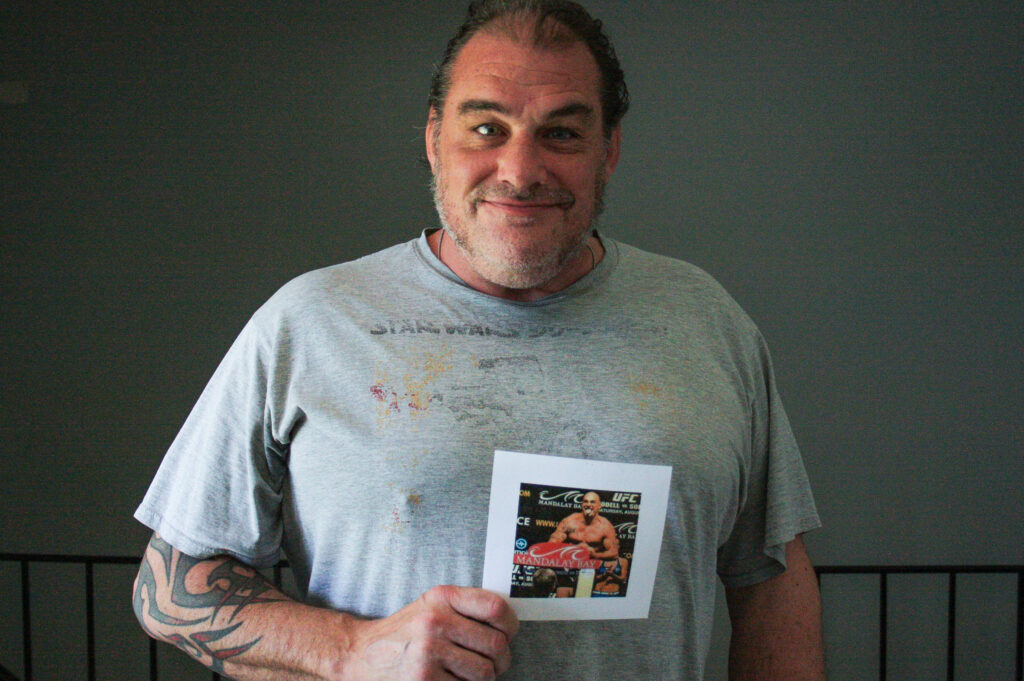
Cory Walmsley stands inside his sober house in Burnsville, Minn., on May 29. He holds up a picture of him at his weigh-in at UFC 62.
Cory Walmsley fought at UFC 62 under the name “Hard Cor” Cory Walmsley. For a decade, he endured the grind of the independent professional wrestling world, under the name Wicked Lester Brody, with a reputation for aggression in the ring and wild camaraderie beyond it.
But in late November 2025, all that mattered was that he showed up to a sober house in Burnsville after a relapse.
Walmsley, 55, first got sober in 2024, inspired by his dog Coco. He had spent most of his career in the independent pro wrestling scene, doing small shows in local venues. For most of that time, he says, his use of drugs and alcohol was seamlessly integrated with all parts of his life — partying with his friends and managing the pain of his work. But that was until the use became unmanageable, he said.
“One thing addicts are really good at is being in denial,” Walmsley said. “As long as I went to work and made it to my job, and if I wasn’t hung over or in horrible shape — whatever, I just thought. No, I’m not an addict.”
Pain and parties
According to the National Library of Medicine, around 16% of wrestlers’ deaths occur under age 50 and are typically because of ongoing health battles or substance abuse issues sustained throughout their wrestling career.
Pro wrestling companies started to push back on wrestlers using drugs in 2006. The WWE implemented a wellness policy that year, which mandated drug tests to make sure wrestlers stay off steroids, painkillers and any other addictive drug. If wrestlers fail, they can be suspended for 30 to 90 days.
Yet Walmsley entered wrestling at a time when wrestlers were largely oblivious to the hazards of the sport, from physical injuries such as torn muscles or dislocated spinal discs to the consequential risks of addiction. Those trying to make it to the top echelons, such as the WWE and World Championship Wrestling, pushed their bodies to fight through injuries. This often led to abuse of painkillers, weed, alcohol or anything wrestlers could get their hands on to fight through the pain.
Walmsley also loved the party scene that wrestling brought, typical of many who entered the pro wrestling world in the 1990s — the men who wrestled hard, drank hard, oblivious to the body. The rules were made to be broken when it came to hanging out with other wrestlers and going out to the bars.
“Back in the day, we just loved to party afterwards. There was almost never a show where we didn’t find a bar to party at afterwards,” Walmsley said. “I mean, if you name a local wrestler who was famous in the ’80s or ’90s, I probably got high with them.”
Looking back
In a room on the second floor of the sober house, Walmsley sits surrounded by posters and pictures of his wrestling life. The main one is a huge black-and-white poster of him with his wrestling friends in a celebratory pose and beers in their hands. They called themselves the Inhumane Society. It remains one of Walmsley’s fondest memories in pro wrestling.
“We would just go in there, beat guys up. Do mean things, dump water on them,” Walmsley said. “We would just legit go out to the ring, have a bunch of fun.”
Walmsley did not grow up a wrestling fan. He loved working out and powerlifting in high school, and some pro wrestlers recommended he pursue the venture. In late 1996, he began doing heavy powerlifting at the “Gym,” a facility located on Glacier Lane in Plymouth, Minnesota, where wrestlers from all over would come and work out when in the state. The Gym closed in 2011.
“I was a little turned off, just because there were so many slime balls in the business,” Walmsley said.
But he was attracted to the friendships he saw forming when he watched the independent wrestling scene, where new wrestlers competed in smaller gyms or local bars. So Walmsley began doing shows for his friend Travis Shillington, a former pro wrestler and current trainer, who runs a wrestling company and camp in Iowa. He also did a few shows in Minnesota and Wisconsin.
Wrestling requires months to years of training before the performer goes into the ring. They have to go to camp and learn how to safely handle themselves and opponents in the ring.
“I always like to tell people that it’s not like a D1 football program necessarily, or a Navy SEAL training program, but hey, it’s demanding,” Shillington said. “It was every week, and our camp was on weekends, so on Saturday and Sunday, we spent several hours doing a lot of work on the mat before we ever even got into the ring.”
During Walmsley’s time in wrestling, big companies would hire wrestlers from the independent scene. The pressure never had been higher. Wrestlers were constantly competing to one-up each other.
“It takes a tremendous amount of work to be terrible at this. I mean, guys put a lot of time and effort, diet and gym time, ordering gear, and they do a lot, and they can still be awful,” Shillington said. “It takes a lot of time to get the experience and get comfortable in front of a crowd, and there’s just so many different challenges.”
In all this time, Walmsley said his drug use was not an issue for him. Being able to party trumped being able to wrestle. He was influenced by the likes of wrestling legends Curt Henig, the Road Warriors and Wayne Bloom — all of whom got high, drank and partied as a matter of course.
“I couldn’t have cared less if I actually had to wrestle,” Walmsley said. “I just wanted to be there for the after party.”
Sitting with his past
In spring 2026, Walmsley journeyed from his sober house to an independent wrestling event in South St. Paul. Walmsley watched the matches silently, occasionally giving critiques as the face-offs rolled out one after another. A match began that featured a big wrestler who Walmsley said reminded him of his own aggressive wrestling style.
“In the ’80s and ’90s, they just wanted big, huge, roided-out guys in the ring, where now, especially now, if you can do some really good, high-flying stuff…if you can do some really cool, dangerous shit, you can be a small guy and do good in the business,” Walmsley said.
The seats of the event were filled with children, parents and older adults. Walmsley stood on the side for three matches and the opening segment promo, until his back and knees started to bother him too much to stay.
In the early 2000s, as he was reaching his thirties, Walmsley dealt with multiple injuries. He tore his rotator cuff and hurt his back to the point where he now can’t stand for more than 20 minutes. Eventually, he could not even work out.
“Trying to be in the gym, trying to get big and stay big while you’ve always got some shoulder injury, always got some back injury, always got some knee injuries. Something always hurts,” Walmsley said.
Walmsley said that he has torn his rotator cuffs many times in matches. He has worked wrestling events with a beat-up back, bad knees and sore arms. Hitting the ring was hard on Walmsley’s body. He would negotiate matches to avoid too much pounding.
“If you want a really good match, you’re going to be hurt afterwards,” Walmsley said.
As he looks back, Walmsley says the pressure, the injuries and the substance abuse led to anxiety, depression and intense self-criticism. Managing the dynamic of staying in the game, on the one hand, and feeling inadequate, on the other, was sometimes overwhelming for Walmsley. He never wanted to rewatch his matches.
“I was really self-critical. I would watch it, and my friends would be like, Oh, that looked great,” Walmsley said. “I was like, ‘’Nah, that looked horrible.’ I didn’t like that. And I said, I was a really sloppy wrestler to begin with.”
Turning to alcohol and drugs made it all easier, especially when wrestling was no longer part of Walmsley’s life, but the injuries continued to linger.
But to his wrestling peers, he appeared only as a decent professional.
Dave Arrowood, former pro wrestler and one of Walmsley’s best friends, said Walmsley has a vulnerability at his core.
“Cory is kind of a different guy, a child at heart. He’s kind of a loving guy,” Arrowood said.
James Jefferies, 37, now a pro wrestler and trainer for Impact Pro Wrestling, recalls his early days facing Walmsley in a few matches. He described Walmsley as “like a gentle giant outside the ring,” someone who was caring and kind to other wrestlers working, while also slamming them down in the ring.
“Basically it was: Get beat on by [him],” Jefferies said, “because he was so much bigger and stronger. So he always took care of me.”
Struggling to heal
In the nearly 20 years Jefferies has been involved with pro wrestling, he has seen wrestlers move away from wrestling because of mental health challenges that are exacerbated by the stresses of the sport.
“Just wanting to have longevity in it,” Jefferies said. “I know it gets just harder as the years go by to think, ‘Hey, am I still performing at the rate that I once did?’ And I think a lot of guys and gals struggle with that from time to time.”
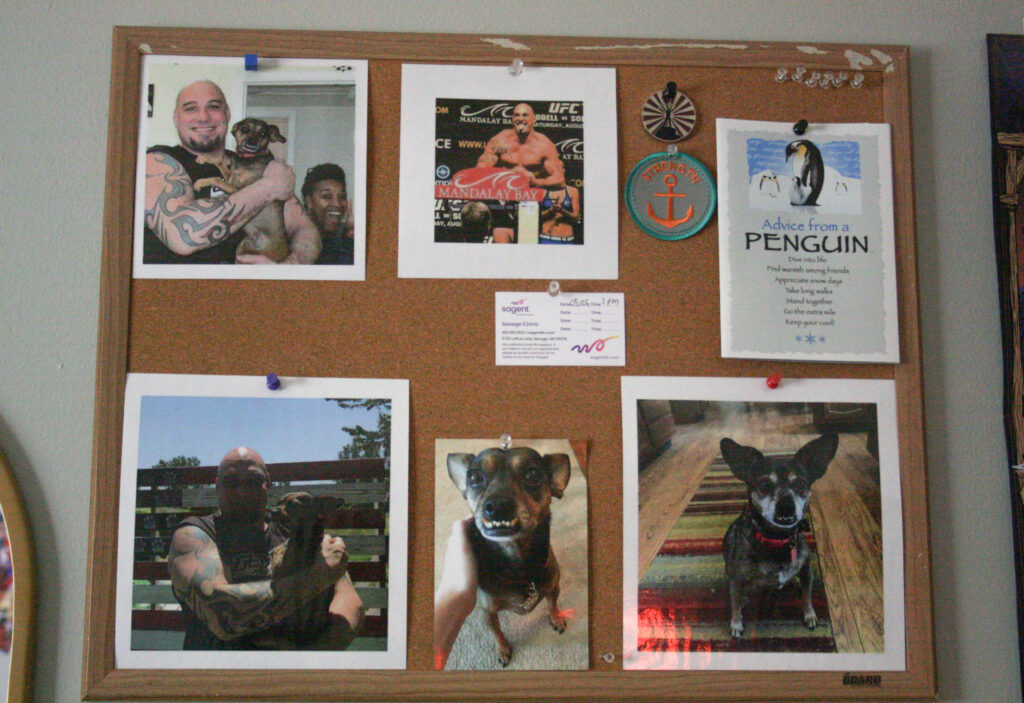
Pictures of Cory Walmsley’s dog, Coco, hang up on his wall at the sober house in Burnsville on May 29.
Walmsley stopped wrestling altogether in 2006. He began working at different jobs during his time after wrestling. He worked as a caregiver for a person with Down syndrome and picked up work as a delivery driver for DoorDash.
In 2018, Walmsley decided to get Coco, a small rat-terrier mix, who never barked or misbehaved, he said. Coco changed his priorities, he said, and he wanted to give the dog the best possible life. He got sober and attended Alcoholics Anonymous meetings.
“Anytime I’ve gone to an AA meeting, I always feel better walking out,” Walmsley said. “And the one thing I would tell anybody is, if you’re just lonely and want to be around some nice people, go to a fucking AA meeting.”
In November 2025, Coco died. Walmsley, overwhelmed by grief, relapsed. He entered treatment and wound up in sober living. For now, the wrestler formerly known as Wicked Lester Brody, who regards his time with UFC 62 as the accomplishment of his life, says he keeps his aspirations simple.
“I’m trying to see if there’s another sober house I can get into that would be closer to my sister,” Walmsley said, “and that they’re medical-marijuana friendly, which is a big help for me.”